Super Lawyers
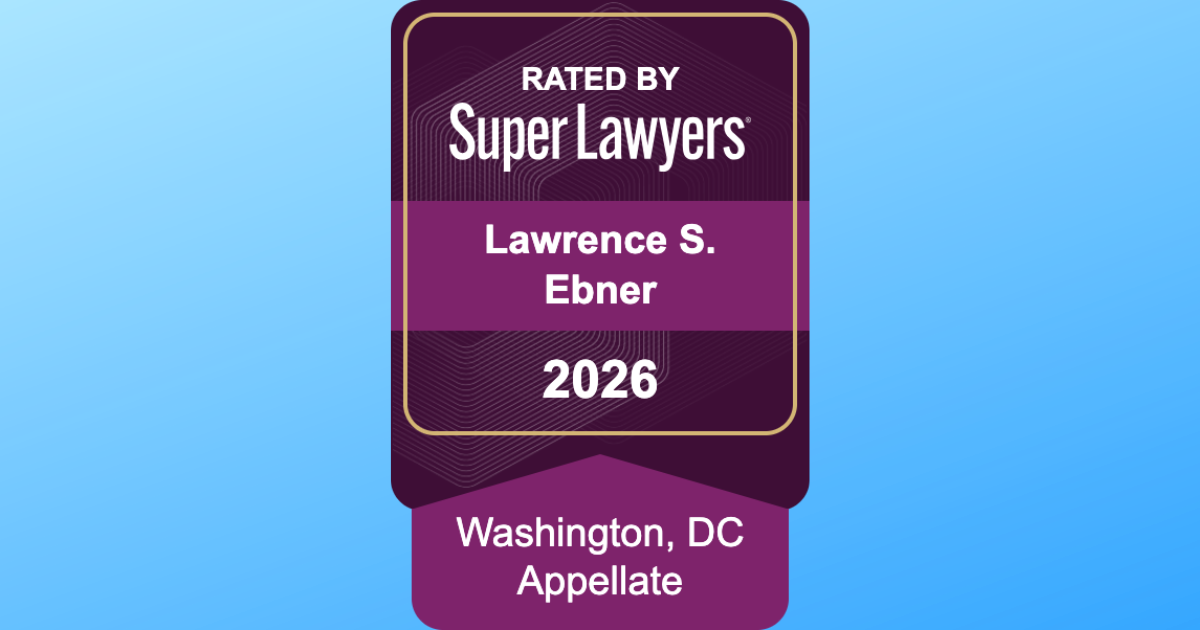
I am honored to have been selected by Thomson Reuters as a Washington, D.C. Super Lawyer – Appellate for the 9th consecutive year. I am one of relatively few solo practioners to have received this recogition.
More than 60 state and local governments have filed state-law tort suits in state courts around the United States collectively seeking billions of dollars in damages and other relief from major oil and natural gas producers for the alleged local effects of global climate change. Preclusion of these proliferating climate-change tort suits is crucial not
Supreme Court Should Hold That Federal Law Precludes Climate-Change Tort Suits Read More »
Under Pennsylvania and Minnesota laws, companies that register to do business in those states are deemed to have consented to the state’s general (“all purpose”) jurisdiction. This means that an out-of-state corporation can be sued by an out-of-state plaintiff for a cause of action that has no connection to Pennsylvania or Minnesota. All states have
ALF Amicus Briefs Urge Supreme Court To Revisit State Consent-By-Registration Statutes Read More »
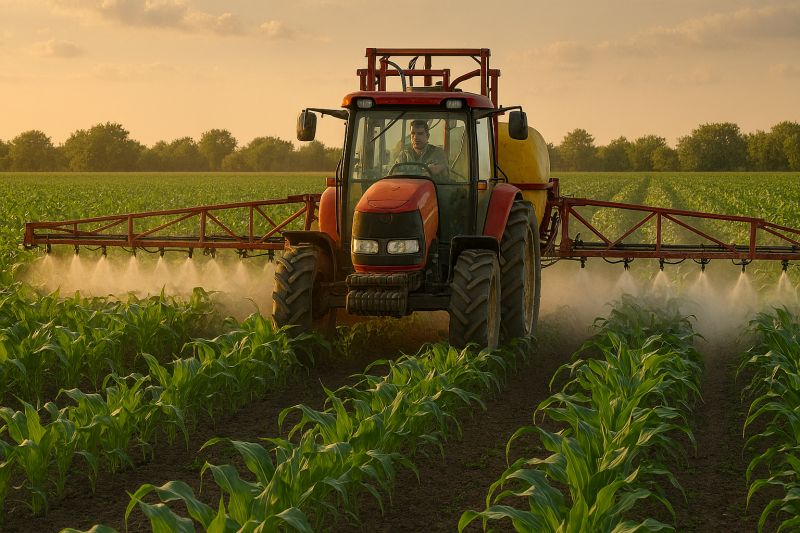
On April 22, 2026 ALF Executive Vice President & General Counsel Larry Ebner participated in a webinar panel previewing the Supreme Court oral argument in Monsanto Co. v. Durnell (24-1068). The question presented by the case is whether FIFRA, the federal pesticide regulatory statute, preempts state-law failure-to-warn claims based on a pesticide producer’s failure to provide a
Monsanto Co. v. Durnell: A Supreme Court Oral Argument Preview Read More »
For more than 50 years the Securities and Exchange Commission (SEC) has been enforcing a “Gag Rule,” 17 C.F.R. § 202.5(e), whenever a civil enforcement target enters into a judicial or administrative settlement agreement with the Commission. The Gag Rule requires settling enforcement targets to agree that they will not publicly deny any allegation in
ALF Urges Supreme Court To Review & Invalidate SEC “Gag Rule” Read More »
I was pleased to be part of a panel on “Amicus Briefs at the Trial and Appellate Levels” at the Federation of Defense & Corporate Counsel’s Winter Meeting in Scottsdale, Arizona on February 27, 2026. The panel, sponsored by FDCC’s Appellate Law Section, which I chair, was moderated by Angela Flowers and also included Matt
Amicus Briefs At The Trial and Appellate Levels Read More »
On January 16, 2026 the Supreme Court granted certiorari in Monsanto Co. v. Durnell (24-1068) to address the question of whether the Federal Insecticide, Fungicide, and Rodenticide Act (FIFRA) preempts pesticide label-related failure-to-warn claims where U.S. EPA does not require the warning at issue. The answer to this question will affect state-law personal injury claims alleging that Monsanto
Supreme Court Should End Roundup Failure-To-Warn Litigation Read More »
On January 16, 2026, the Supreme Court granted certiorari in Monsanto Co. v. Durnell (24-1068) to address the following question: “Whether the Federal Insecticide, Fungicide, and Rodenticide Act [FIFRA] preempts a label-based failure-to-warn claim where EPA has not required the warning.” The answer to this question could result in dismissal of tens of thousands of
My FIFRA Preemption Journey Read More »
On behalf of the Atlantic Legal Foundation, I have written and filed an amicus brief supporting the pending petitions for a writ of certiorari in Janssen Pharmaceuticals, Inc. v. Kennedy (25-749) & Bristol Myers Squibb Co. v. Kennedy (25-751). Both petitions ask the Supreme Court to hold the Inflation Reduction Act’s misleadingly named “Drug Price Negotiation Program” unconstitutional. Case
ALF Urges Supreme Court To Review & Invalidate “Drug Price Negotiation Program” Read More »
When Fidel Castro captured power in 1959, his Cuban government expropriated billions of dollars in American-owned business property. A 1972 U.S. Foreign Claims Settlement Commission report explained that Castro’s “unlawful seizures violated every standard by which the nationals of the free world conduct their affairs.” The stolen business property included an oil refinery, product terminals and